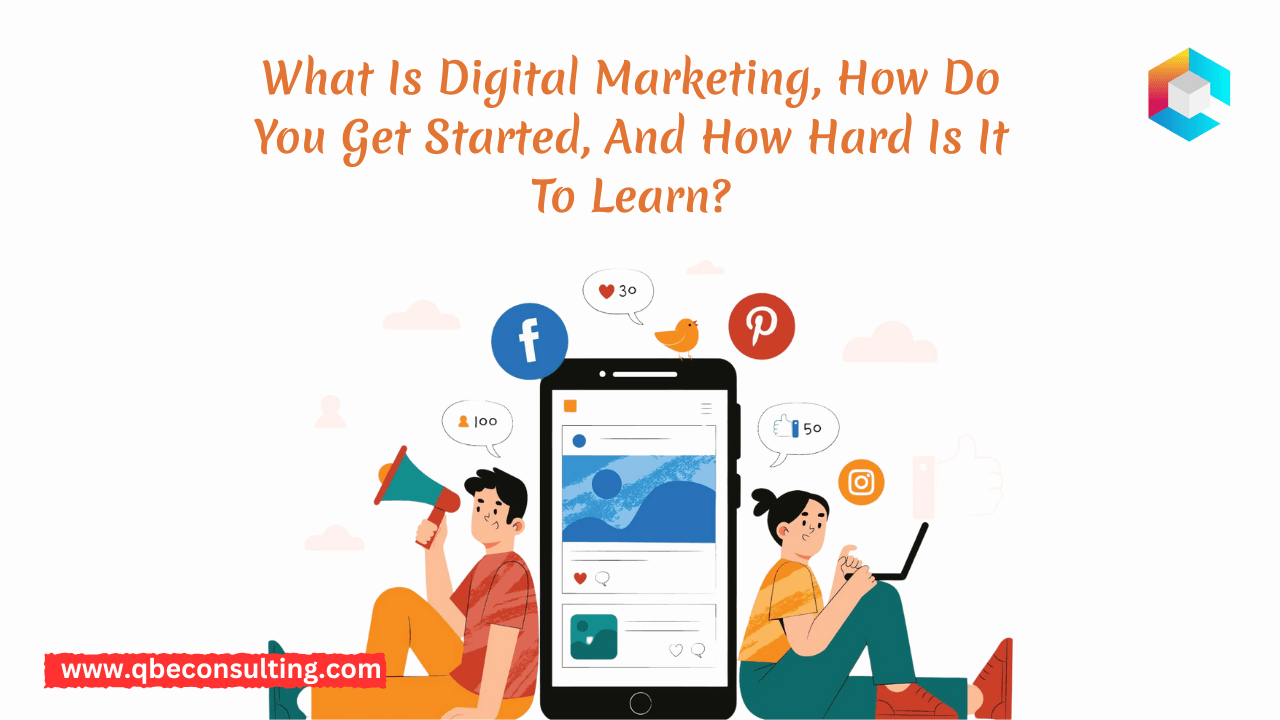
Are you a business owner who is having trouble getting your business off the ground online? Or are you thinking about changing careers and getting into the exciting world of online marketing? You are asking the right things. In today’s world, two of the most important things you can do for your business or career are “What is digital marketing?” and “How do you start digital marketing?”
The digital world is no longer just a nice-to-have; it’s where businesses get noticed, connect with customers, and make money. This full guide from QBE Consulting will help you understand the most important parts of this important practice and show you how to get started.
What Exactly Is Digital Marketing?
Digital marketing is a general term for all marketing that uses the internet or an electronic device. In short, it’s any kind of online ad.
Digital marketing is different from traditional marketing (like print ads, billboards, and TV commercials) because it gives you instant feedback, lets you target very specific audiences, and shows you how much money you made (ROI). It reaches potential customers where they spend most of their time: online. It does this by using a lot of different channels, like social media and search engines.
This field has a lot of different areas of study, each with its own set of strategies, tools, and best practices.
The 8 Core Pillars of Digital Marketing
You need one plan that uses a lot of these main channels to do well online.
- SEO (Search Engine Optimization)
Search engine optimization (SEO) is the process of improving your website so that it shows up higher in search engine results pages (SERPs) like Google, Bing, and DuckDuckGo. The goal is to get more people to go to your website without having to pay for it.
Key Focus: The main goals are to get high-quality backlinks, make the site’s content better (keywords, quality), and make sure it is technically sound (speed, mobile-friendliness).
Why It Matters: Over time, high search rankings bring in a steady stream of free, highly qualified traffic. - Pay-Per-Click (PPC) Advertising
Pay-per-click (PPC) is a kind of online advertising where companies pay a fee every time someone clicks on one of their ads. You can pay for visits to your site instead of getting them naturally. The most common type is Google Ads, where you bid on keywords.
Key Focus:Managing your budget, bidding on keywords, writing ad copy, and making your landing page better are the main things to focus on.
Why It Matters: It gives you immediate visibility and measurable results, which makes it great for sales and lead generation campaigns that need to happen right away. - Content marketing
Content marketing is a planned way to make and share useful, relevant, and consistent content that will attract and keep a specific audience and, in the end, get them to take profitable actions.
Key Focus: The main goal is to create blog posts, e-books, videos, podcasts, and infographics that help customers solve their problems or find the answers to their questions.
Why It Matters: It helps you gain trust, gives you authority, and boosts all of your other marketing efforts, especially SEO and social media. - Social media marketing (SMM)
Social media marketing is all about using Facebook, Instagram, LinkedIn, TikTok, and X (formerly Twitter) to connect with your audience, raise brand awareness, get traffic, and get leads. Key Focus:The main goals are to make interesting content (like pictures, videos, and text), run targeted paid ads, manage the community, and see how people interact with the content.
Why It Matters:It lets you talk to customers directly and focus on certain groups of people based on their demographics and psychographics. - Email Marketing
Email marketing is a cheap and effective way to talk to customers and potential customers directly through email. It is often used to keep customers coming back, grow leads, and make more sales.
Key Focus:The main goals are to grow a healthy list of subscribers, group audiences, create personalized email campaigns, and keep track of open and click-through rates.
Why It Matters:It’s one of the best digital marketing channels for getting a good return on investment (ROI) because you’re only marketing to people who have already said they want to hear from you. - Affiliate Marketing
Affiliate marketing is a way for businesses to pay one or more affiliates for each visitor or customer that the affiliate brings in through their own marketing. You only pay for what you get. Key Focus: Get the word out about your products by working with bloggers, review sites, or influencers who will get a cut of the sales.
Why It Matters: It’s a plan with little risk and a lot of reward that uses the trust and reach of famous people or brands. - Influencer Marketing
Influencer marketing is a more specific type of social media and affiliate marketing that works with “influencers,” or people who already have a lot of followers on social media.
Key Focus:The main goal is to get influencers to post sponsored content, reviews of products, or endorsements of your brand. Why It Matters: It gives your brand real, trusted endorsements that can quickly reach large, niche groups of people. - Mobile Marketing
Mobile marketing is a set of strategies that businesses use to reach people on their phones and tablets. This includes making websites work better on phones and tablets, using social media ads that only show up on phones and tablets, and using SMS and in-app ads. Key Focus:The main goal is to make sure that all online assets work well on mobile devices, which is important for both SEO and user experience. Also, make ad formats that work well on mobile devices. Why It Matters: Most of the traffic on the internet comes from mobile devices, so businesses today need to put mobile first.
How Do You Start Digital Marketing?
If you jump into all eight pillars at once, you’ll get tired. You need to be focused and have a plan to get off to a good start. Here’s a simple four-step plan:
Find out who your audience is and what you want to achieve
Before you spend any time or money on a channel, you need to ask yourself two important questions:
Who are you trying to reach?Make detailed buyer personas that include things like their age, where they live, what they like, what problems they have, and what social media sites they use.
What do you want to achieve? Your goals should be SMART: specific, measurable, achievable, relevant, and time-bound. “Get 15% more qualified leads from SEO in the next six months” is one example.
Build Your Core Foundation
- Your website is your main hub, and your content is what makes it work.
Make sure your business website loads quickly, works well on phones and tablets, and clearly explains what you do.
Start with Content (and SEO): Make content that is high quality and answers the questions your audience has. This is the foundation of both SEO and content marketing. Do some basic keyword research to make sure that search engines can find your content. - Choose one or two channels to learn about. Based on what you learned about your audience, pick one main traffic channel and one main conversion channel.
Example 1 (B2B): Use LinkedIn SMM to network with other professionals and email marketing to stay in touch with leads. Example 2 (E-commerce): Use PPC ads on Google and social media to make sales right away, and use Instagram SMM to grow your brand. Take Action: Before you grow, promise yourself that you will learn how to use these two channels and the best ways to do so. - Use data and make changes when necessary Digital marketing is great because you can track it. Set up Google Analytics (or something similar) on the first day. Check your Key Performance Indicators (KPIs), which include things like website traffic, conversion rates, cost-per-click (CPC), and more. Look at your data often to see what is and isn’t working, and then change your plan. You will be successful in the long run if you keep analyzing and making things better. Is it hard to learn how to market online? No, the basics aren’t hard to learn, but you have to keep changing and practicing to really master them. Digital marketing isn’t really about coding; it’s more about planning, being creative, and looking at data. Making a social media page, running a simple PPC ad, or improving a blog post for SEO are all things that are very easy to learn.
Is Digital Marketing Hard to Learn?
There are so many fields (all eight of the ones listed above!) that it can be hard to learn everything at once. The answer is to focus on one thing. Choose one or two areas that fit with your business or career goals.What is digital marketing, how do you get started, and how hard is it to learn?
Are you a business owner who is having trouble getting your business off the ground online? Or are you thinking about changing careers and getting into the exciting world of online marketing? You are asking the right things. In today’s world, two of the most important things you can do for your business or career are “What is digital marketing?” and “How do you start digital marketing?”
The digital world is no longer just a nice-to-have; it’s where businesses get noticed, connect with customers, and make money. This full guide from QBE Consulting will help you understand the most important parts of this important practice and show you how to get started.
What Exactly Is Digital Marketing?
Digital marketing is a general term for all marketing that uses the internet or an electronic device. In short, it’s any kind of online ad.
Digital marketing is different from traditional marketing (like print ads, billboards, and TV commercials) because it gives you instant feedback, lets you target very specific audiences, and shows you how much money you made (ROI). It reaches potential customers where they spend most of their time: online. It does this by using a lot of different channels, like social media and search engines
This field has a lot of different areas of study, each with its own set of strategies, tools, and best practices.
The 8 Core Pillars of Digital Marketing
You need one plan that uses a lot of these main channels to do well online
- SEO (Search Engine Optimization)
Search engine optimization (SEO) is the process of improving your website so that it shows up higher in search engine results pages (SERPs) like Google, Bing, and DuckDuckGo. The goal is to get more people to go to your website without having to pay for it.
Key Focus: The main goals are to get high-quality backlinks, make the site’s content better (keywords, quality), and make sure it is technically sound (speed, mobile-friendliness). Why It Matters: Over time, high search rankings bring in a steady stream of free, highly qualified traffic. 2.Pay-Per-Click (PPC) Advertising
Pay-per-click (PPC) is a kind of online advertising where companies pay a fee every time someone clicks on one of their ads. You can pay for visits to your site instead of getting them naturally. The most common type is Google Ads, where you bid on keywords. - Content marketing
Content marketing is a planned way to make and share useful, relevant, and consistent content that will attract and keep a specific audience and, in the end, get them to take profitable actions. - Social media marketing (SMM)
Social media marketing is all about using Facebook, Instagram, LinkedIn, TikTok, and X (formerly Twitter) to connect with your audience, raise brand awareness, get traffic, and get leads. - Email Marketing
Email marketing is a cheap and effective way to talk to customers and potential customers directly through email. It is often used to keep customers coming back, grow leads, and make more sales. - Affiliate Marketing
Affiliate marketing is a way for businesses to pay one or more affiliates for each visitor or customer that the affiliate brings in through their own marketing. You only pay for what you get. - Influencer Marketing
Influencer marketing is a more specific type of social media and affiliate marketing that works with “influencers,” or people who already have a lot of followers on social media. - Mobile Marketing
Mobile marketing is a set of strategies that businesses use to reach people on their phones and tablets. This includes making websites work better on phones and tablets, using social media ads that only show up on phones and tablets, and using SMS and in-app ads.
How Do You Start Digital Marketing?
If you jump into all eight pillars at once, you’ll get tired. You need to be focused and have a plan to get off to a good start. Here’s a simple four-step plan:
Find out who your audience is and what you want to achieve
Before you spend any time or money on a channel, you need to ask yourself two important questions:
Who are you trying to reach?Make detailed buyer personas that include things like their age, where they live, what they like, what problems they have, and what social media sites they use.
What do you want to achieve? Your goals should be SMART: specific, measurable, achievable, relevant, and time-bound. “Get 15% more qualified leads from SEO in the next six months” is one example.
Build Your Core Foundation
Your website is your main hub, and your content is what makes it work.
Make sure your business website loads quickly, works well on phones and tablets, and clearly explains what you do.
Start with Content (and SEO): Make content that is high quality and answers the questions your audience has. This is the foundation of both SEO and content marketing. Do some basic keyword research to make sure that search engines can find your content.
Choose one or two channels to learn about. Based on what you learned about your audience, pick one main traffic channel and one main conversion channel.
Example 1 (B2B): Use LinkedIn SMM to network with other professionals and email marketing to stay in touch with leads. Example 2 (E-commerce): Use PPC ads on Google and social media to make sales right away, and use Instagram SMM to grow your brand. Take Action: Before you grow, promise yourself that you will learn how to use these two channels and the best ways to do so.
Use data and make changes when necessary Digital marketing is great because you can track it. Set up Google Analytics (or something similar) on the first day. Check your Key Performance Indicators (KPIs), which include things like website traffic, conversion rates, cost-per-click (CPC), and more. Look at your data often to see what is and isn’t working, and then change your plan. You will be successful in the long run if you keep analyzing and making things better. Is it hard to learn how to market online? No, the basics aren’t hard to learn, but you have to keep changing and practicing to really master them. Digital marketing isn’t really about coding; it’s more about planning, being creative, and looking at data. Making a social media page, running a simple PPC ad, or improving a blog post for SEO are all things that are very easy to learn.
Is Digital Marketing Hard to Learn?
There are so many fields (all eight of the ones listed above!) that it can be hard to learn everything at once. The answer is to focus on one thing. Choose one or two areas that fit with your business or career goals.
The rules for advertising, the features of social media platforms, and the algorithms used by search engines are always changing. This means that a good digital marketer is always learning new things.
You can’t learn SEO by just reading articles; you have to practice. You need to make a website, write content, and keep track of how well it does to really get the ideas.
The rules for advertising, the features of social media platforms, and the algorithms used by search engines are always changing. This means that a good digital marketer is always learning new things.
You can’t learn SEO by just reading articles; you have to practice. You need to make a website, write content, and keep track of how well it does to really get the ideas.